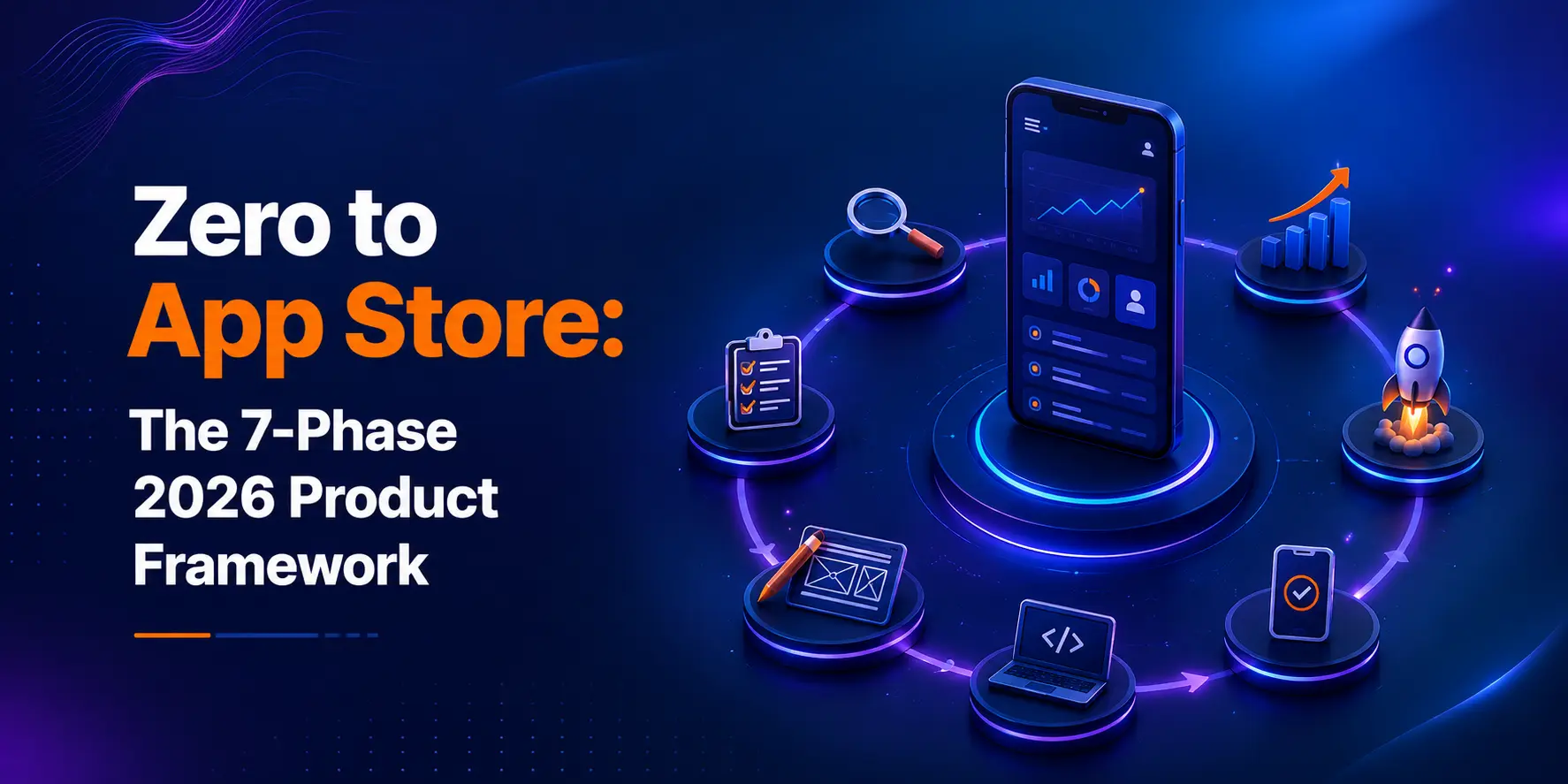
To turn your business idea into a mobile app in 2026, follow this 7-phase acceleration framework: validate your idea with market research and define your MVP, choose between native (iOS/Android), cross-platform (Flutter/React Native), or no-code development based on your budget and timeline, design intuitive UI/UX with wireframes and prototypes, develop the frontend and backend with AI-powered tools and cloud integration (AWS/Azure), test thoroughly for security, performance, and functionality through beta testing, submit to the App Store and Google Play following their guidelines with optimized ASO, and launch with analytics tracking, continuous updates, and monetization strategies like subscriptions or in-app purchases to grow your user base and revenue.
Introduction
The mobile app development market has been booming, with mobile applications becoming a primary way for users to interact with digital services.
Stats
According to Grand View Research, the global mobile application market was valued at approximately USD 252.89 Billion in 2023 and it is expected to reach USD 626.89 Billion by 2030 with a CAGR of ↑ 14.3% from 2024 to 2030.
Mobile device users have spent more than 90% of their time within apps, making mobile applications a critical channel for customer engagement and business growth.
If a business owner or entrepreneur has an idea for creating a mobile app, he/she is not alone. There are thousands of innovators exploring mobile app development opportunities every single day. A successful idea is one that turns into a launch-ready application, which requires more than coding. It demands thorough market validation, strategic planning, user-focused design, efficient development, rigorous testing, and a well-executed launch strategy. This complete guide walks you through a proven 7-phase acceleration framework that helps businesses transform raw concepts into scalable, market-ready mobile apps in 2026.
Phase 1: Validate app idea with MVP focus
Before making an investment in mobile app development, business owners must ensure that the app idea addresses a genuine customer need and aligns with market demand. Without proper validation, developing an app may result in wasted resources, delays in launch, and low user adoption. The very first step is to think about and understand the target audience, identify their challenges, and create a proper strategy for how the app can provide better solutions than existing alternatives.
The process starts with analyzing competitors in the industry by reviewing their features, customer feedback, ratings, and uncovering gaps in the market. From there, define the UVP (Unique Value Proposition), which will be the key benefit that differentiates the app from competitors and helps users choose the best solution.
For building a successful mobile app, you need to understand users in detail. Once this is done, it becomes easier to prioritize the right features for development.
- Create a clear ICP (Ideal Customer Profile) that defines the ideal user, the problems they face, and how they interact with mobile apps.
- Prioritize features using these insights so they solve critical customer problems.
- Create the Minimum Viable Product (MVP) by focusing on the essential features identified.
- Launch the MVP to speed up time-to-market, validate key assumptions, and reduce initial development costs.
- Advanced features can be delayed until after validating the app, ensuring that resources are invested only in what users actually need.
By focusing on validation and MVP planning, business owners can minimize risk, make clearer investment decisions, and build a strong foundation for long-term app success. Research shows that many apps fail because they do not focus on this phase, even though it is the most critical step in the mobile app journey.
Phase 2: Choose Your Development Approach Based on Budget and Timeline
Selecting the right development approach is a strategic decision for business owners, as it directly impacts cost efficiency, time-to-market, scalability, and long-term ROI. In 2026, mobile app development should not be a business owner’s choice alone. It should align with business goals, budget, and the desired launch timeline.
| Development Approach | Pros | Cons | Best For |
| Native Development (iOS / Android) | Highest performance, smooth UX, full access to device features (camera, GPS, biometrics, notifications) | Higher development cost, longer development time (6–12 months), requires two codebases | Enterprises, fintech apps, high-performance or feature-rich applications |
| Cross-Platform Development (Flutter / React Native) | 30–40% lower cost, faster development (4–8 months), up to 90% code reuse | Slight performance trade-offs, limited access to some native device features | Most business apps, startups, MVPs, SaaS products, scalable business solutions |
| No-Code Development | Fastest launch (5–7 weeks), lowest cost, easy updates and iteration | Limited customization, platform dependency, scalability limitations for complex apps | MVPs, internal tools, simple apps, non-technical founders validating ideas |
In 2026, cross-platform development with Flutter and React Native has become the dominant option for most businesses, which may be driven by improved performance, AI-assisted coding tools, and a reduced development cycle. Meanwhile, no-code platforms have gained traction for rapid MVP creation and early market validation.
Phase 3: Design for User Engagement and Retention
A great idea alone is not enough to put an app on the path to success. Business owners should focus on critical factors like customer satisfaction, engagement, and retention, which can impact the achievement of business goals. Even the most innovative application may struggle if users find it difficult to navigate or use. Researchers have studied and analyzed that a poor user experience may lead to a low engagement rate and reduced conversions.
The business should focus on following design activities to create an application which users enjoy and continue using it.
- Wireframes: Visualize the basic screen layout of the app structure, navigation, and user flow before the development process begins.
- User Journey mapping: Map the user move in the application to complete the important task and to find the potential friction points.
- High-Fidelity Mockups: Develop complete visual designs which may include branding, colours, typography, and user interface elements.
- Interactive Prototypes: Build a Clickable version to test the application with user interaction and collect the feedback before coding starts.
- User Testing: Plan for usability testing with target users to identify the navigation issues, workflows and feedback for improvements.
These activities will help businesses to reduce the development risk and ensure the final product aligns as per customer expectations and objectives. The Application design should be validated before the development process begins so that businesses can avoid costly changes. Business owners should prioritize navigation, fast loading screens, and seamless user journeys which can enable users to achieve their goals.
Phase 4: Build and Integrate Your App
This stage is where the mobile app moves from design concepts to a functional product. For business owners, the development phase is where the actual investments begin translating into tangible business value. Modern development tools and cloud technologies have significantly reduced timelines while improving efficiency, scalability, and reliability. A successful mobile application requires both frontend and backend.
Frontend Development
The frontend helps in delivering a smooth and engaging user experience. The Development teams focus on:
- Implementing user interface components based on approved designs
- Using animations and creative elements
- Ensuring responsiveness across different devices and screen sizes
- Optimizing speed, performance, and usability
Backend Development
The backend manages data processing, security, and application logic. The Key development activities include:
- Creating database architecture using SQL or NoSQL technologies
- Building APIs for seamless data communication
- Creating user authentication and access controls
- Enabling push notifications and real-time functionality
Cloud Integration
Cloud platforms play an important role in ensuring scalability and business continuity. Best solutions include:
AWS: Serverless computing, cloud storage, AI integrations, and scalable infrastructure
Microsoft Azure: AI services, cloud databases, enterprise security, and identity management
As user demand grows Cloud-based infrastructure allows businesses to scale resources by maintaining high levels of security and performance.
AI-assisted development tools can automate repetitive coding processes, help development teams work more efficiently, and also reduce timelines. Businesses that combine skilled development teams with AI-powered tools and cloud infrastructure can accelerate their path to market while delivering a reliable and future-ready mobile application.
Phase 5: Test and Validate Your App
Before launching the mobile application, it is essential to verify that every feature works as required and provides a better user experience. Testing helps prevent costly issues, protect brand reputation, and improve customer satisfaction. Identifying and fixing problems during development is more cost-effective than addressing issues after they reach users.
To verify that the application is market ready, testing should focus on the below following key areas:
| Testing Type | Purpose | Business Value |
| Functional Testing | Verify that all features, workflows, and user interactions work as expected and meet business requirements | Ensures users can complete actions without errors and reduces operational issues |
| Performance Testing | Evaluate app speed, responsiveness, and stability under different usage conditions | Improves customer experience and prevents slow performance or app crashes |
| Security Testing | Identify vulnerabilities, validate data encryption, and test authentication systems | Protects customer data, builds trust, and reduces security risks |
| Compatibility Testing | Test app functionality across multiple devices, operating systems, screen sizes, and network environments | Delivers a consistent user experience across all platforms |
| Beta Testing | Release the app to a selected group of users for real-world feedback and testing | Helps identify usability issues and improve the product before launch |
A combination of automated and manual testing provides the best results. Automated tools help identify bugs and performance issues quickly, while manual testing helps evaluate the overall user experience. In the current era, AI-powered testing solutions further accelerate quality assurance by detecting potential issues earlier and predicting risks before launch.
Phase 6: App Store Launch
App Store Optimization (ASO) strategy helps fulfill the required guidelines and optimize visibility for potential users. It helps improve discoverability, increase downloads, and reduce delays during the review period.
App Store Optimization (ASO) checklist:
App Title: Use the primary keywords with the character limit of 100 max for iOS & 30 for Google Play)
Description: Write compelling copy with keywords naturally integrated
Screenshots: Use 5 to 8 high quality screenshots of app features
App Icon: Creative design with professional icon in 1024×1024 pixels
Keywords: Research and include relevant keywords in metadata
Privacy Policy: Include URL to privacy policy (required for submission)
Age Rating: Complete questionnaire for appropriate age classification
Submission process:
- Create developer account – $99/yr for App Store, $25 one-time for Play Store
- Collect the required assets like screenshots, descriptions, icons & etc.
- Submit for review Apple App Store: 24-48 hours, Google Play Store: 2-7 days)
- Address rejection issues if any
- Schedule launch date
By completing this phase, businesses can move beyond development and position their app for a stronger market entry, improved discoverability, higher user acquisition, and sustainable long-term growth.
Phase 7: Launch and Scale Your App
The important milestone is launching the mobile application, but for business owners, it represents the beginning point of their long-term growth strategy. Many businesses still do not focus on monitoring mobile app performance. A successful mobile application requires continuous monitoring, data-driven improvements, and strategic monetization efforts to remain competitive in the market.
One of the most important aspects of post-launch success is tracking analytics. Here are some of the key metrics to focus on when tracking app performance.
Analytics Tracking
- Downloads: Track daily, weekly, and monthly app downloads to measure acquisition trends and growth performance.
- Engagement: Monitor session duration, screens viewed per session, and Daily Active Users (DAU) to understand user interaction levels.
- Retention: Measure Day 1, Day 7, and Day 30 retention rates to evaluate how effectively users continue using the app.
- Conversion: Track free-to-paid conversions, subscription signups, and feature adoption rates to assess business performance.
- Analytics Tools: Use platforms such as Firebase, Mixpanel, Amplitude, and App Annie to collect and analyze user behavior data.
Another critical component is monetization strategies that align with business objectives and user expectations. Choosing a proper revenue model will not only generate income, but it will also contribute to long-term sustainability and customer retention. Businesses can leverage many approaches, including in-app purchases for premium features, subscription plans for recurring revenue, freemium models that encourage upgrades, and advertisement-based revenue streams. Many organizations in 2026 have adopted hybrid monetization models that use different methods to maximize revenue opportunities while maintaining a positive user experience.
Conclusion
Building a successful mobile application in 2026 requires a structured and end-to-end approach that goes beyond coding. The above 7-phase framework, from idea validation, UI/UX design, development, testing, app store launch, and post-launch optimization, ensures that businesses create apps that are user-focused and market-ready. Each phase plays a vital role in reducing risks, improving efficiency, and aligning the mobile app with real customer needs.
When all 7 phases are executed properly, businesses benefit from faster time-to-market, better user engagement, and stronger revenue potential. Market research ensures the right product is built, UI/UX enhances usability, development with AI and cloud improves performance, testing ensures reliability, and ASO combined with analytics drives visibility and continuous improvement.
In many cases, businesses collaborate with professional app development companies to execute this entire strategy effectively. A mobile app development company integrates all these phases into a streamlined process, combining technical expertise with strategic execution to ensure best practices across development, security, scalability, and user experience. It may also support post-launch activities such as analytics tracking, feature updates, performance optimization, and monetization strategy improvements.
By partnering with an app development company, businesses can transform their ideas into high-performing mobile applications that ensure sustained growth, user retention, and long-term success in this competitive mobile ecosystem.